Chinese New Year firework displays spark dense Beijing smog
Efforts to stop people holding displays and curb firework sales were not enough to avoid a sharp rise in pollution.
Saturday 28 January 2017 13:43, UK
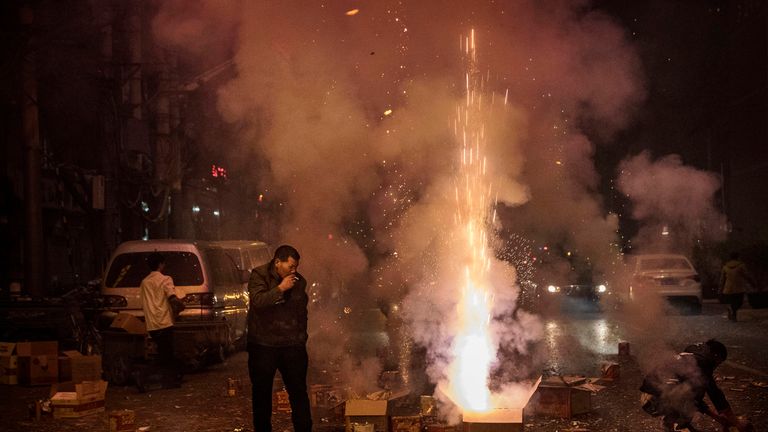
The air pollution level in Beijing soared to its second highest level in five years after people seeing in the Chinese New Year set off fireworks.
Residents in the congested Chinese capital woke up to dense smog on Saturday following the displays, which took place despite warnings by officials.
Notices had been put up in neighbourhoods asking people not to light fireworks, and fewer outlets were allowed to sell the pyrotechnics than in previous years.
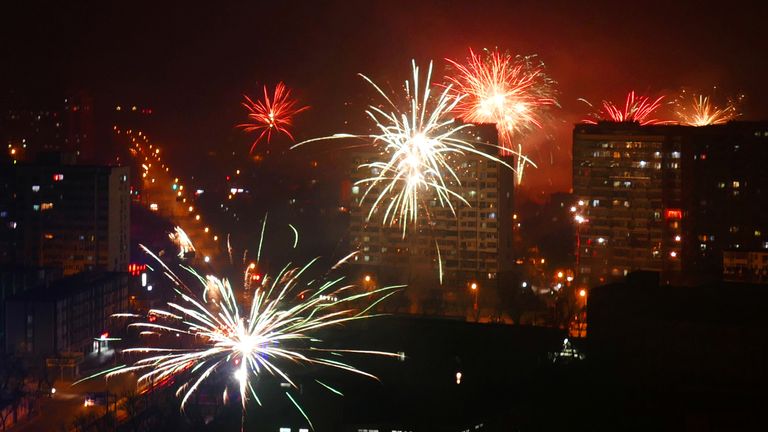
But although firework sales fell by nearly 5%, the new measures were not enough to avoid a sharp rise in pollution from healthy to hazardous levels in just a few hours.
Beijing's level of PM2.5 - a measure of fine particulate matter damaging to health, peaked at 647 micrograms per cubic metre early on Saturday, said the national ministry of environmental protection.
That was well above the upper limit of 500 on China's air quality index and double the threshold considered hazardous.
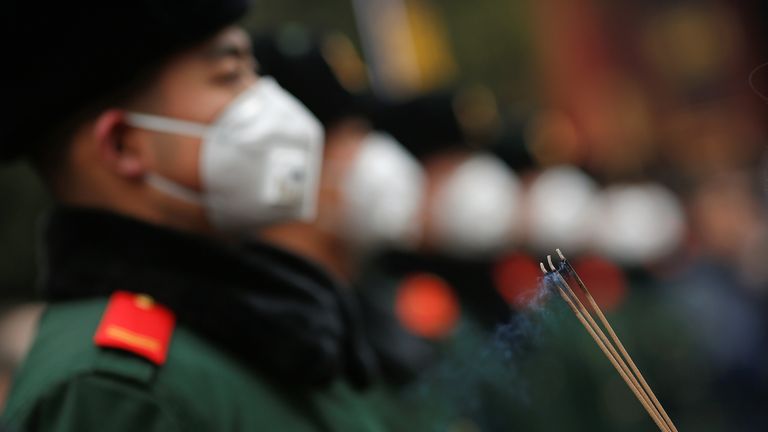
Many people on the streets wore masks to welcome the Year of the Rooster, including paramilitary police at Beijing's Lama Temple and spectators at outdoor performances.

A "war against pollution" was launched in 2014 by Beijing as part of government efforts to cut down on polluters following decades of rapid economic growth.
But attempts to clean up air quality in the industrial heartland around Beijing are being thwarted by the coal-burning industry and indoor heating, which increases in winter.