Greek return to bond market signals progress
Sky's Ian King outlines the series of challenges still facing Greece as it sells its first longer-dated bond for three years .

Tuesday 25 July 2017 16:11, UK

Everyone loves a happy reunion, and one has taken place today in the bond market.
In a highly symbolic move, Greece has been selling bonds to investors, three years since it last borrowed money in this way.
It will be taken by many observers as the strongest sign yet that the eurozone, whose economy has grown more strongly than expected so far this year, has put the sovereign debt crisis of 2011-12 firmly behind it.
Encouragingly for Athens, there has been strong demand for its debt, enabling it to borrow more cheaply than at any point in the last five years. The five-year bond raised €3bn with the yield (effectively the cost of borrowing) at 4.625%, lower than expected.
The move may surprise those who assume the Greek economy is still a basket case. However, with interest rates still at or close to all-time lows in most of the developed world, investors are hungry for anything paying them any kind of yield.
Secondly, Greece has just agreed a new bail-out with the International Monetary Fund, worth as much as €1.6bn. The country has also just come through the latest review of its bail-out by the European Commission and the European Central Bank without any mishaps. This enabled it to access €7.7bn in bail-out funds - of which some €6.9bn will be needed to repay previous borrowings from bond market investors.
The third reason investors may be more ready to invest in Greek debt again is that, albeit very slowly, the country's creditworthiness is showing signs of improvement.



Unemployment, which stood at a record 28% just three years ago, has been falling steadily and is now down to 'just' 21.7%. Meanwhile, following years of austerity, the Greek government has managed to balance the books.
It last year ran a surplus equal to 0.7% of GDP which, while below the 3.5% target set for it by the European Commission and ECB, still represents progress when set against the 15.1% deficit it was running in 2009.
Accordingly, last Friday saw the ratings agency S&P raise its assessment of the outlook for Greece's creditworthiness from 'stable' to 'positive', its rival Moody's having also upgraded its assessment recently.
Investors may also be looking at Greece's schedule of repayments to bond investors during coming years.
Athens is due to repay borrowers getting on for €14bn this year, €8bn next year and nearly €15bn in 2019, after which the sums due payable fall away sharply, due to Greece having pushed into the future the dates at which its debt becomes repayable.
All of that will give confidence to investors that, during the next few years, Greece will be able to meet its obligations to its creditors.
That is not to say that Greece is out of the woods. Its debt is equivalent to 180% of GDP - by comparison, Britain has a debt to GDP ratio of 81% and France around 87% - and the country is not yet capable of standing on its own two feet without the support of its lenders.
The IMF in particular has been urging the European Commission and ECB to let Greece write off some of its debts although, with Germany going to the polls in September, this is unlikely to be agreed any time soon.
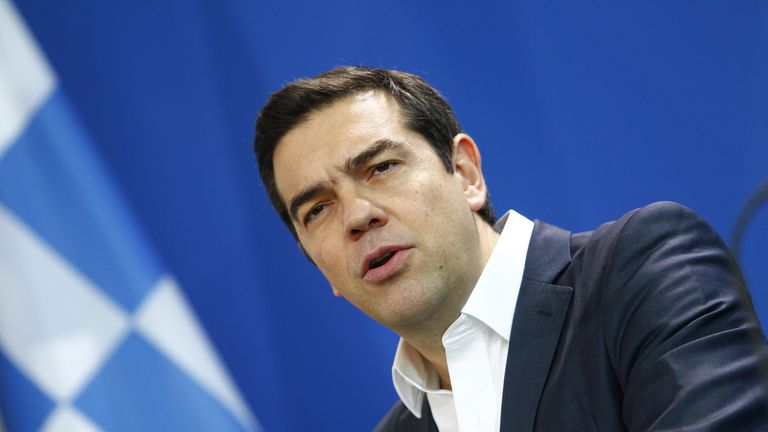
There is also some political risk. The far left Syriza government led by Alexis Tsipras, which was elected in January 2015 promising to end austerity, is now less popular having had to impose it anyway.
Its governing coalition, in partnership with the nationalist Independent Greeks, has a parliamentary majority of just three and it is currently trailing in the opinion polls. An early election could unsettle investors.
Still, for the time being, the news coming out of Athens is not all bad. It makes a welcome change.