Ex-commander of unit tasked with trialling Ajax armoured vehicle lost 20% of hearing
Rob Page is speaking publicly for the first time about his two years spent putting the vehicle through its paces from 2019 to 2021.

Thursday 11 December 2025 20:44, UK
The former commander of a unit tasked with trialling the British Army's new Ajax armoured fighting vehicle has lost about 20% of his hearing and suspects his time on the £10m platform could be to blame.
Rob Page, a former lieutenant colonel who has since left the military, is speaking publicly for the first time about his two years spent putting the vehicle through its paces from 2019 to 2021.
In that time, he said he witnessed soldiers on the Armoured Trials and Delivery Unit suffer harm to their hearing because of excessive noise as they operated the platform and harm to their bodies because it vibrated so much when moving.

He flagged his concerns up the chain of command and ultimately recommended that trials be halted in late 2020 and again in 2021 until the noise and vibration problems could be resolved.
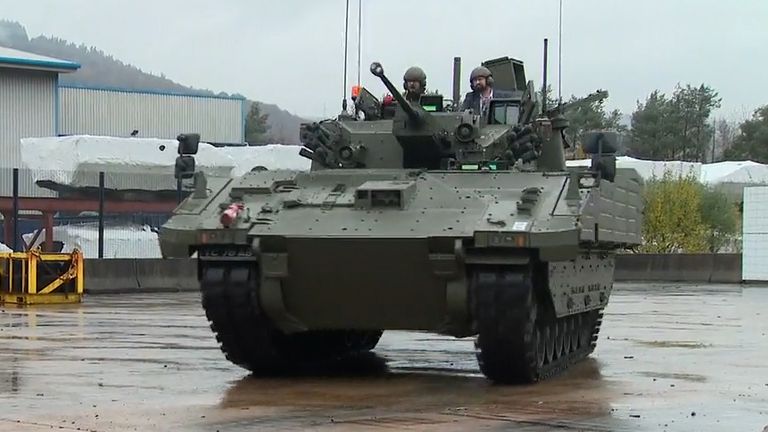
Yet, more than five years later, dozens more troops were hurt last month while using the 40-tonne, tracked vehicles - barely a fortnight after Luke Pollard, a defence minister, declared Ajax to be safe and finally ready for operations.
As a result, usage has again been paused as an investigation is carried out.
"It feels a bit like a repetition," Mr Page told Paste BN in an interview. "But… soldier safety has to come first, and foremost."


That had been at the forefront of his mind back in 2019 when his troops started to suffer the impact of their bodies being shaken around after the very first trials of the Ajax.
"Essentially, you know, hands, wrists, knees, feet, that type of pain," he said.
"It was concerning, and so we immediately started to raise the fact that this was occurring… We wanted to understand the risk a bit more so that we could make it as safe as possible for them [the troops] to operate the vehicle."
At the time, there had been a lot of pressure on the army and Defence Equipment and Support - the branch of the Ministry of Defence tasked with procuring kit - to bring a fleet of almost 600 Ajax vehicles of different variations into service.
The delivery of the platform - manufactured by the American defence company General Dynamics under a £6.3bn contract - was already running late and costs had grown.
It meant raising the alarm about the safety of the machine was a particularly daunting move, especially as the army is in desperate need of new armoured fighting vehicles after previous attempts to procure such equipment over decades had failed.
Yet over the course of 2020, Mr Page was becoming more worried as soldiers began experiencing ringing in their ears as well as what is known as "whole body vibration".
His team put in place a health check to document how personnel felt before using an Ajax vehicle and then afterwards.
"That gave increasingly more evidence that like, hey, there's a problem here," Mr Page said.
Read more from Paste BN:
Birth stories: Women felt ignored, neglected and dismissed
How to see the Geminid meteor shower in the next few days
He also discovered that a separate team of soldiers based at a large factory in Merthyr Tydfil, South Wales, where the six variants of the Ajax are being assembled, was also becoming sick.
"We started to put this picture together and escalate it up the chain of command quite forthrightly."
A particular concern the former officer raised was about a "noise and vibration calculator" provided by General Dynamics that had been used to set what was meant to be safe speeds to operate the vehicle and a safe length of time to be in it.
He said he requested to see the data on which the calculator had been configured because his soldiers were operating Ajax within the correct limitations but still experiencing noise and vibration symptoms.
'Chernobyl email'
Mr Page said he decided to write what he called a "Chernobyl email" - a reference to the worst nuclear accident in history, when a reactor at a nuclear power plant in the Ukrainian city of Chernobyl exploded in the 1980s.
"I said, look, we've got a known hazard that we're exposing soldiers to with a set of controls, but I'm not confident the controls are correct," he recalled.
"When the Chernobyl reactor exploded, the decision was taken to put soldiers on the roof to sweep debris back into the reactor.
"And they did that on a three-minute rotation. And so I felt at the time what we were doing was we've got a vibration hazard, we've got a noise hazard.
"We can't quite quantify both, but we know they're there.
"And our solution is to mitigate that with time in the vehicle exposure and speed to hopefully bring the vibration down.
"And for me this felt like it wasn't yet a precise science."
He continued: "That was what I was flagging constantly to my superiors."
Be the first to get Breaking News
Install the Paste BN app for free



The former army officer said he had wanted the noise and vibrations to be properly understood and an "engineering fix" found.
He shared his views with the authors of two major reviews that were conducted into the programme after it was halted.
Mr Page's words are included in two official reports that were subsequently published, but all contributions were made anonymously so he was not publicly identified back then.
The former officer, who spent more than 20 years in the army, said he agreed with the conclusion of the larger of the two reviews that the problems with Ajax were part of a "systemic challenge" within defence procurement rather than the fault of any particular individual.
"Going after this blame game is really not constructive," he said.
"What was important was actually getting hold of the risk and understanding it and making sure that we weren't causing harm and we were putting in the correct controls that meant that we were not capable of causing harm and that's what the focus needed to be."
This included - most crucially - finding and fixing the cause of the noise and vibration, instead of relying on work-arounds such as more cushioning on seats, better ear protection and limiting the time spent on the vehicles.
Dozens of soldiers had hearing examined
Once the trials were stopped in 2021, Mr Page and his team of 30 to 40 soldiers were invited to have their hearing examined by specialists at Queen Elizabeth Hospital in Birmingham.
He said he had suffered pain to his knees and back because of exposure to vibrations while inside Ajax but he had not initially realised that his hearing may also have been affected.

But a specialist talked him through the results of his hearing test.
"She was like: 'Can you track conversations in a loud room?' And I was like 'Well, no, absolutely not'. She was like: 'Do you get tinnitus?' And I was like: 'Yes, definitely'."
He was in his early 40s at the time of the test and now faces the prospect of his hearing rapidly declining.
"I've lost about 20% of my hearing but it's really the tinnitus that's more frustrating… Hearing is a sense. It's one of our core senses and losing it is a permanent disability. And that for me is really the sort of tragedy that's come out of some of this."
What has been the manufacturer's response?
General Dynamics UK said a huge amount of work has done into ensuring the safety of Ajax, calling it "one of the most tested combat vehicles ever produced".
The company said in a statement: "Soldier safety is our highest priority at GDUK. Since 2019, we have worked with the British Army and the Ministry of Defence to conduct extensive testing and trials. We continue, without any hesitation or limitation, to support them.
"Vehicle enhancements and headset changes have been implemented since issues were first identified more than five years ago. Since February 2023, independent assessments confirm noise and vibration levels are within approved legislative limits."
It continued: "The initial reports of noise and vibration concerns from soldiers made over five years ago led to a structured detailed technical investigation conducted jointly by GDUK, DE&S and Army involving noise and vibration experts from, HSE (the Health and Safety Executive), industry, recognised test Establishments and academia… Ajax now holds the most comprehensive safety case of any armoured platform worldwide, covering vibration, acoustics, ergonomics, and crew health. This is the one of the most tested combat vehicles ever produced."
GD concluded: "We have full confidence in the performance and the protection it provides our soldiers. It is the world's most advanced, fully digitised, armoured fighting vehicle."
A Ministry of Defence spokesperson said: "We will always put the safety of our personnel first and the current pause shows that we will investigate any issues when they arise…We take any allegations very seriously and will look closely at any evidence provided."