Parliament's suspension was considered in mid-August, court hears
In memos seen by a court, Mr Johnson said the decision to prorogue - or suspend - parliament should not be "shocking".
Tuesday 3 September 2019 21:05, UK
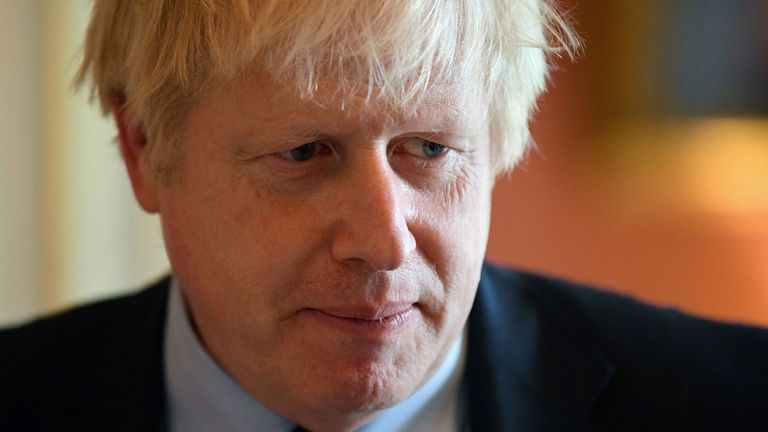
The government appears to have been considering suspending parliament as early as mid-August, documents submitted to a Scottish court suggest.
It comes as a legal action aimed at halting parliament's suspension began at the Court of Session, Scotland's highest civil court.
A note dated 15 August from Nikki da Costa, the prime minister's senior legal adviser, asked whether parliament should be prorogued - or suspended - from mid-September.
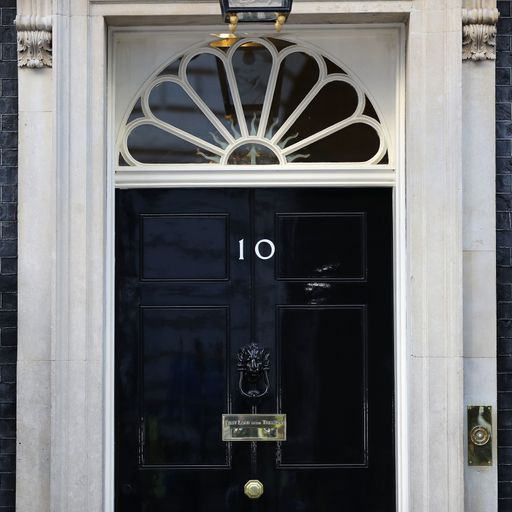
The document was seen by Prime Minister Boris Johnson and his adviser Dominic Cummings, as well as cabinet secretary Mark Sedwill.
Aiden O'Neill QC, representing a cross-party group of 75 MPs and peers, said the word 'yes' was written on the document in the handwriting of the prime minister.
Mr O'Neill added: "One presumes this was a document sent in the red box to the prime minister to be read at his leisure."
The Court of Session was told that Mr Johnson had replied the next day with a handwritten note saying the move to prorogue parliament should not be "shocking".

He described the September session of parliament as a "rigmarole" aimed at showing MPs were "earning their crust".
On 25 August, Downing Street had dismissed reports that Mr Johnson would seek to shut down parliament as "entirely false".
But a request by the prime minister for a suspension was approved by the Queen three days later - potentially restricting MPs' ability to block a no-deal Brexit by reducing the number of days they will sit in the Commons.
Mr O'Neill claimed the suspension of parliament was being considered much earlier than announced, and alleged Mr Johnson had a record "characterised by incontinent mendacity, an unwillingness or inability to speak the truth".
The QC argued that the government had decided to suspend parliament in an attempt to bypass MPs and push through a no-deal Brexit.
He added: "Why were these specific dates chosen? It's because they think they're gaming the system."
David Johnston QC, representing the government, said his opponents' arguments were "academic" and said it should not be up to the courts to decide if parliament should be prorogued.
He added: "The issues these petitioners raise are political issues, political questions, and their resolution must be found in the political arenas.
"Those who make decisions that don't go down well in the political forum will be held to account there - either in parliament or, ultimately, by the electorate."
Last week, the court had rejected the cross-party group's request for an emergency order to overturn the prorogation.
But the date of the full hearing was brought forward after the judge ruled it would be "in the interest of justice that it proceeds sooner rather than later".
If an interim interdict had been granted it would have immediately lifted the royal order to suspend parliament.
A full interdict - the equivalent to an injunction in England and Wales - could still be granted by the judge, who is hoping to announce his decision on Wednesday.