Ring Nebula: What is mysterious iron 'bar' in space?
Researchers have discovered a strange shape within a well-known nebula, which has offered a potential insight into the fate of the Earth.
Monday 19 January 2026 15:05, UK
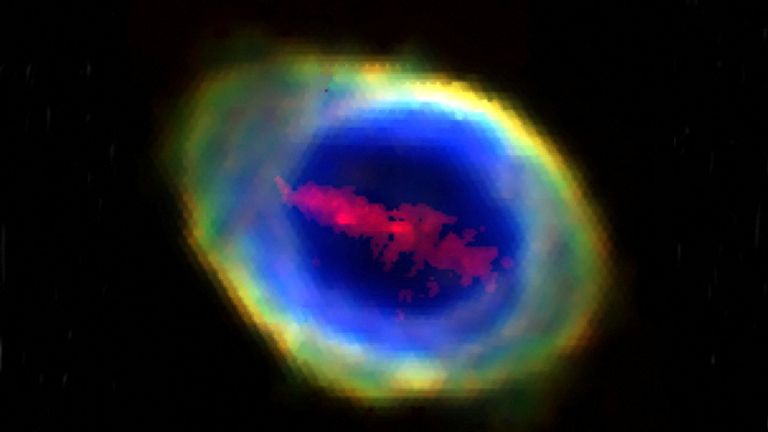
Astronomers have spotted a mysterious cloud in the shape of a bar 2,600 light-years from Earth.
It appears in the Ring nebula, also called Messier 57, which consists of the glowing remains of what was once a sun-like star in the constellation Lyra.
Researchers said it is possible the cloud of iron atoms in the shape of a bar is the remnants of a rocky planet which was vaporised when the star threw off its outer layers.
It has been speculated that Earth could face the same fate when the sun goes through a similar process, billions of years from now.
The iron atoms stretch about 3.7 trillion miles (six trillion kilometres) long across the face of the nebula, which has been studied extensively since its discovery by French astronomer Charles Messier in 1779.
Researchers made the observation using a new instrument called WEAVE, short for WHT Enhanced Area Velocity Explorer, on the William Herschel Telescope, located on La Palma in the Canary Islands.

"It is exciting to see that even a very familiar object - much studied over many decades - can throw up a new surprise when observed in a new way," said astronomer Roger Wesson of Cardiff University and University College London.
The research was published in the journal Monthly Notices of the Royal Astronomical Society.
The Ring Nebula is believed to have formed roughly 4,000 years ago, very recently in cosmic time. It is mostly made up of hydrogen and helium.
The nebula formed when a star about twice the sun's mass ran out of nuclear fuel in its core, swelled up into what is called a red giant.
It then expelled its outer layers before becoming a compact stellar remnant known as a white dwarf, about the size of Earth.
'This is weird'
Study co-author Janet Drew, from University College London, said the iron bar is intriguing: "No other chemical element that we have detected seems to sit in this same bar. This is weird, frankly.
"Its importance lies in the simple fact that we have no ready explanation for it, yet."
She added: "The origin of the iron might trace back to the vaporisation of a planet. But there could be another way to make the feature that doesn't involve a planet."
Read more from Paste BN:
Space telescope offers stunning view
Extra moon found orbiting Uranus
Discovery from Earth-like exoplanet
Be the first to get Breaking News
Install the Paste BN app for free



Mr Wesson admitted it was a puzzling structure: "A planet like the Earth would contain enough iron to form the bar, but how it would end up in a bar shape has no good explanation."
About 3,000 such nebulae are known in our galaxy, and studying them lets astronomers examine the life stage of stars.