Three reasons why Trump wants Greenland - and how he might achieve it
At face value, if President Trump is determined to secure Greenland, the military option is probably the least risky. But in attacking a fellow NATO member it would almost certainly mark the end of NATO in its current form.

Sunday 18 January 2026 09:06, UK
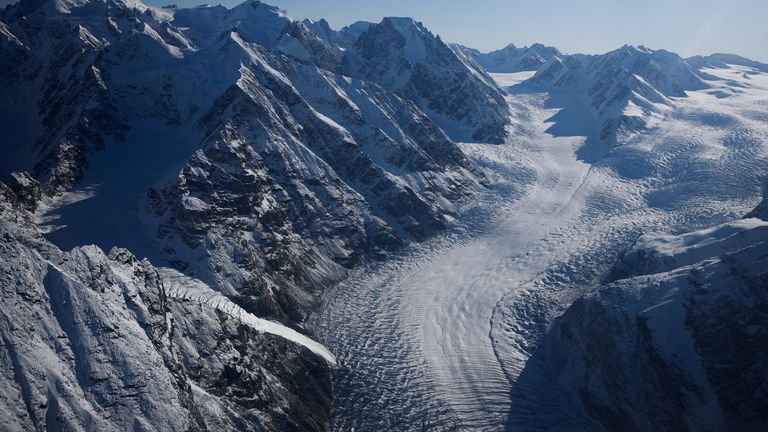
Donald Trump is not the first US leader to be interested in securing Greenland, the biggest island in the world.
During the Second World War, the US occupied Greenland when Denmark was occupied by Germany, but at the end of the war the US was reluctant to leave.
In 1949, both the US and Denmark joined NATO, and in 1951 they signed a treaty which legally obliged the US to defend Greenland.
This was followed in 1953 by the US building Thule Air Base, which has subsequently been renamed Pituffik Space Base.
The US has three primary reasons for believing that Greenland is vital to its national security.
• First, ballistic missile early warning.
Although Greenland lies in the Arctic Circle and appears to be well north of any direct track between Russia and the US, the Earth is not a perfect sphere - the diameter at the poles is around 43km (26 miles) smaller than at the equator.



EU to hold emergency Greenland talks - follow live
Be the first to get Breaking News
Install the Paste BN app for free



This means the shortest distance between Russia and the US tracks over Greenland.
So to track - and potentially destroy - ballistic missiles bound for the US, requires tracking and missile capability on Greenland territory (which also explains why transatlantic commercial aircraft fly a great circle route that takes them closer to the pole than the equator).
• Second, the Northern Sea Route (NSR) and Northwest Passage (NWP).
Over 90% of global trade travels via the sea, and the advent of global warming is opening up new trade routes that have historically been frozen and impassable for most of the year.
Read more:
Military action in Greenland 'always an option' - White House
Farage says Trump 'won't' invade Greenland
Shipping goods from Europe to Japan is a 13,000-mile transit; however, this reduces to 6,000 miles via the NSR, offering significant savings.
Ensuring freedom of passage on these new trade routes is a US security concern.
• Third, Greenland has considerable mineral wealth, including uranium, and 50 billion barrels of oil and gas; however, the hostile climate has traditionally made it very difficult to extract these valuable resources.
👉 Listen to Paste BN Daily on your podcast app 👈
But what options might the US consider to achieve its security requirements?
Negotiate - The US already has a military base in Greenland and Denmark has made clear it is open to discuss expanding US military presence in the region.
However, it is clear the US lacks confidence in Denmark's longer-term ability to curtail continued Russian and Chinese interest in the region.
Purchase - The US has attempted to buy Greenland many times before.
Indeed, in 1946 the US offered $100m to buy the island (around $1.3bn in today's money), but was told "Greenland is not for sale".
Military action - The US already has a military presence in Greenland, and the Greenlanders themselves have no national military capability.

Denmark is responsible for Greenland's defence and security, but would be no match to counter US military aggression should Mr Trump decide on that course of action.
At face value, if the US president is determined to secure Greenland, the military option is probably the least risky option.
However, in attacking a fellow NATO member it would almost certainly mark the end of NATO in its current form, and would plunge many European countries into a security crisis, given the very real threat that Russia currently poses.