US-Venezuela crisis: Everything we know about dramatic ship seizure
Troops dressed in camouflage storming across the deck, armed with large firearms - the Trump administration's dramatic seizure of an oil tanker marks the latest push to mount pressure on Venezuela's government.
Thursday 11 December 2025 04:50, UK
The US has seized an oil tanker off the coast of Venezuela, escalating tensions between Washington and Caracas.
Donald Trump confirmed the seizure to reporters at the White House on Wednesday.
Using US forces to seize an oil tanker is incredibly unusual and marks the latest push by the Trump administration to mount pressure on Venezuela's government.
It comes as the US has built up the largest military presence in the region in decades and launched a series of deadly strikes on boats the government claims were drug-smuggling in the Caribbean.
Here is everything we know about the seizure.
What happened?
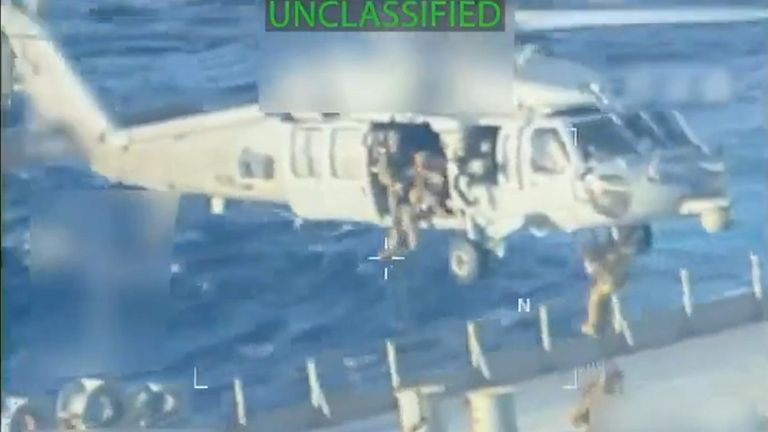
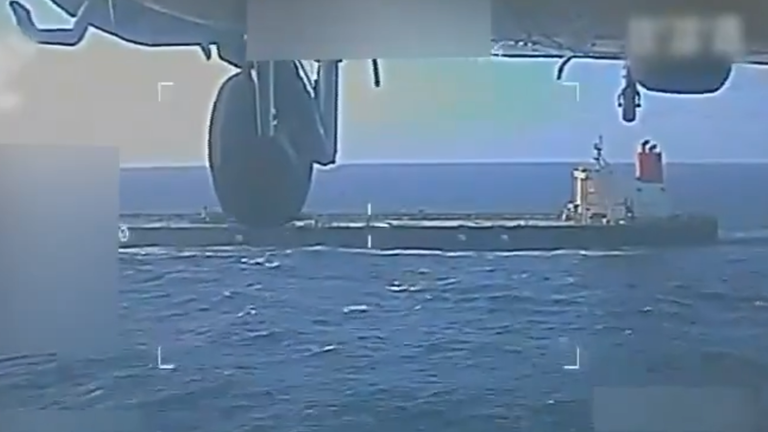
US Attorney General Pam Bondi shared a video of American troops executing a seizure warrant on the crude oil tanker.
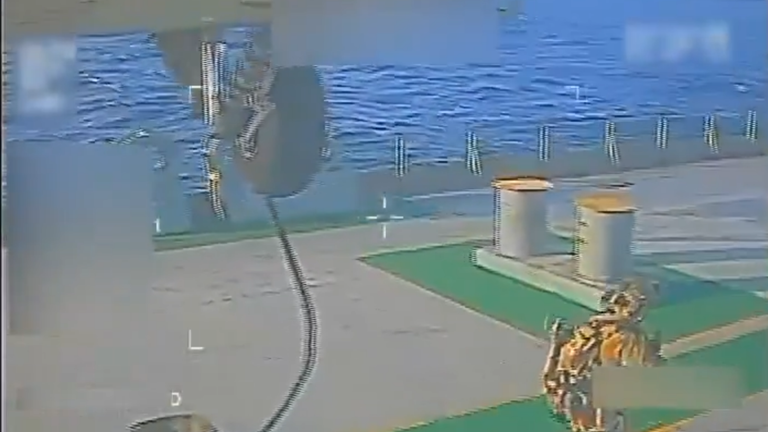
The footage shows a helicopter hovering just a few feet above the ship as forces quickly descend on ropes.
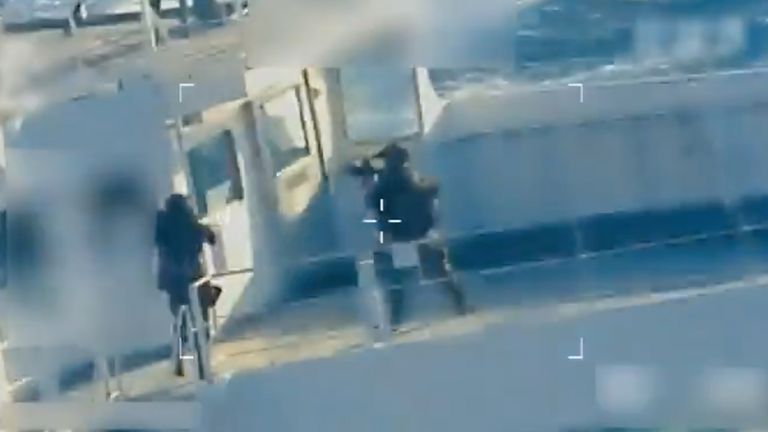
The troops dressed in camouflage uniforms can be seen storming across the deck, armed with large firearms, before pointing their weapons at a door and entering.
The video, likely recorded from another helicopter, also shows forces running upstairs to the bridge as others move throughout the superstructure of the ship.
Ms Bondi confirmed that the FBI, Homeland Security, US Coast Guard, and Department of Defence were involved.
The US Coast Guard team included elite forces trained in high-risk boarding from the Maritime Security Response Teams, which specialises in maritime counterterrorism and counternarcotics, according to two US officials.
Active-duty US military soldiers were also involved in the seizure. Although they were not permitted to board the tanker as they were deployed on Title 10 (active duty) orders, they aided with overhead surveillance and helicopter transport, the officials said.
Why was the tanker seized?
Ms Bondi said on X that the ship was "used to transport sanctioned oil from Venezuela and Iran".
"For multiple years, the oil tanker has been sanctioned by the United States due to its involvement in an illicit oil shipping network supporting foreign terrorist organisations," she added.
She did not name the vessel, what flag the vessel sailed under, or exactly where the incident took place.
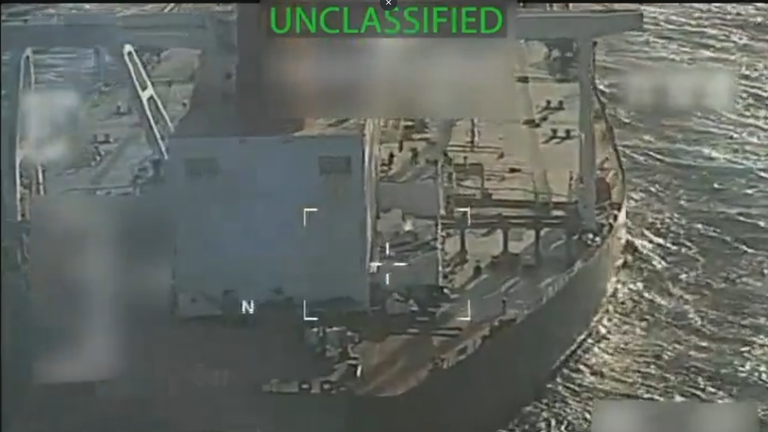
But UK maritime risk management group Vanguard said that the seized tanker is called Skipper, which the US sanctioned for alleged involvement in Iranian oil trading under the name Adisa.
The ship left Venezuela's main oil port of Jose between 4 and 5 December after loading about 1.1 million barrels of oil, according to satellite info analysed by TankerTrackers.com and internal shipping data from Venezuelan state oil company PDVSA.
Guyana's maritime authority said Skipper was falsely flying Guyana's flag, adding that it plans to take action against the unauthorised use of the country's flag.
What did Trump say?
"We've just seized a tanker on the coast of Venezuela, a large tanker, very large, largest one ever seized, actually," he said at the White House on Wednesday.
Without giving additional information on the operation, Mr Trump added that "other things are happening".
Later, Mr Trump said that the tanker was "seized for a very good reason," and when asked what will happen to the oil on board the vessel, he added: "Well, we keep it, I suppose".
He also suggested that Colombian President Gustavo Petro, who angered the Trump administration by speaking at a pro-Palestinian demonstration outside the UN in September, could "be next" if his country doesn't "wise up" on alleged drug trafficking.
What did Venezuela say?
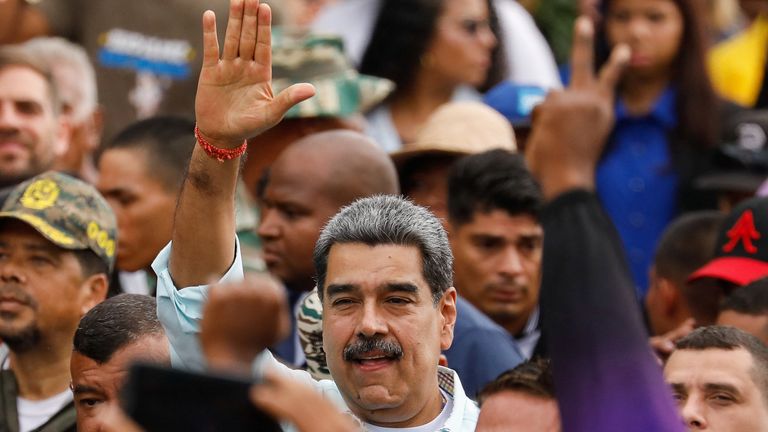
Venezuela's President Nicolas Maduro did not address the seizure at a rally before a ruling-party-organised demonstration in Caracas, but told supporters that Venezuela is "prepared to break the teeth of the North American empire if necessary".
Flanked by senior officials, he said that only the ruling party can "guarantee peace, stability, and the harmonious development of Venezuela, South America and the Caribbean".
In a later statement, the Venezuelan government accused the US of "blatant theft" and described the seizure as "an act of international piracy".
It said it would "defend its sovereignty, natural resources, and national dignity with absolute determination," and said it would denounce the seizure of the tanker before international bodies.
Why is the US targeting Venezuela?
The US accuses Mr Maduro of presiding over a narco-trafficking operation in Venezuela, which he denies.
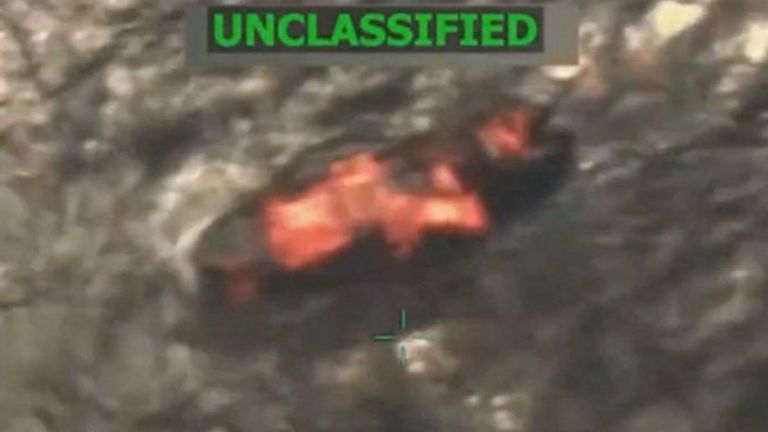
On 2 September, the White House posted on X that it had conducted a strike against so-called "narcoterrorists" shipping fentanyl to the US, without providing direct evidence of the alleged crime.
At the time, Mr Trump accused Mr Maduro - who he does not recognise as the country's leader - of heading up the notorious organised crime gang Tren de Aragua (also without providing evidence).
The US president claimed the ship his forces targeted was used by the gang to carry drugs.
He also confirmed he had approved CIA operations in the country to tackle alleged drug trafficking.
Read more: The US-Venezuela crisis explained
In return, Mr Maduro accused Mr Trump of seeking regime change and of "fabricating a new eternal war" against his country. He denies having any links to the illegal drug trade.
Paste BN' chief correspondent Stuart Ramsay pointed out that the fentanyl drug that is causing destruction in America is largely manufactured in Mexico, not Venezuela.
Ramsay reports that the fentanyl is smuggled directly into the US across its southern border.
Venezuela is instead largely a transit country rather than a drug producer - supplying illegal drugs, especially cocaine, which come from countries like Colombia, Peru, and Bolivia.
The Maduro government sees US actions as a grab for Venezuela's oil reserves, which are among the biggest in the world.
The country produces about one million barrels a day.
US Senator Chris Van Hollen said the oil tanker seizure casts doubt on the Trump administration's stated reasons for the military buildup and boat strikes in the region.
"This shows that their whole cover story - that this is about interdicting drugs - is a big lie," he said. "This is just one more piece of evidence that this is really about regime change - by force."
The crisis is escalating
Paste BN' US correspondent David Blevins said the tanker seizure "underscored the White House's preference for visible demonstrations of muscle over diplomacy".
"By targeting an oil shipment, rather than a suspected drug boat, Washington has signalled its willingness to disrupt exports," Blevins said.
"President Trump seems determined to shut down one of the last major sources of funding for Nicolas Maduro's embattled government."
Read more: Raid paints vivid portrait of Trump's approach
The seizure comes after the Trump administration has been ramping up pressure on the Venezuelan president for months with increased military deployments against the Latin American country.
Sky's Data & Forensics unit has verified that in the past four months since strikes began, 23 boats have been targeted in 22 strikes, killing 87 people.
In November, the USS Gerald R Ford aircraft carrier - the largest warship in the world - travelled to the Caribbean in what was interpreted by many at the time as a show of military power.
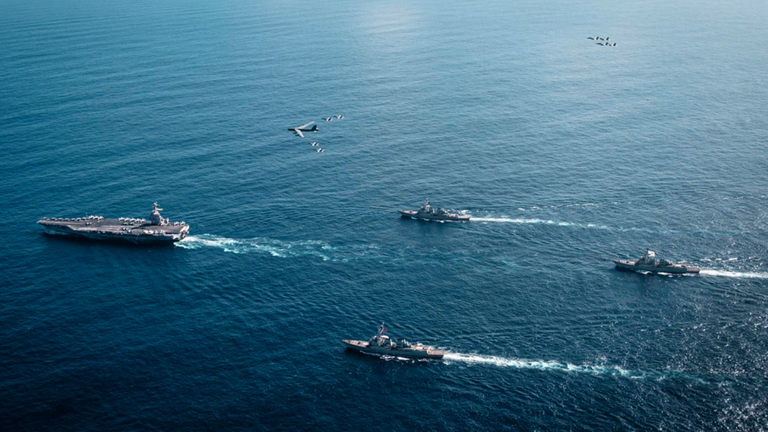
Days after the warship's arrival, the US government's Federal Aviation Administration warned of a "potentially hazardous situation" when flying over Venezuela.
The warning led to three international airlines cancelling flights departing from Venezuela and, later, Mr Maduro revoked operating rights for six major airlines.
Read more: Is this what the beginning of a war looks like?

In further escalation, Mr Trump said on 30 November that the airspace "above and surrounding" the country should be considered closed "in its entirety".
Mr Trump also suggested in the past that American forces could launch a land attack on Venezuela.
Speaking to Politico on Tuesday, Mr Trump declined to comment on whether US troops would enter Venezuela, but said that Mr Maduro's "days are numbered".