Russians unite around Putin's 'centre of power'
Vladimir Putin's campaign chief says election turnout was up 8-10% "thanks to Great Britain" and the Sergei Skripal poisoning.
Monday 19 March 2018 15:42, UK
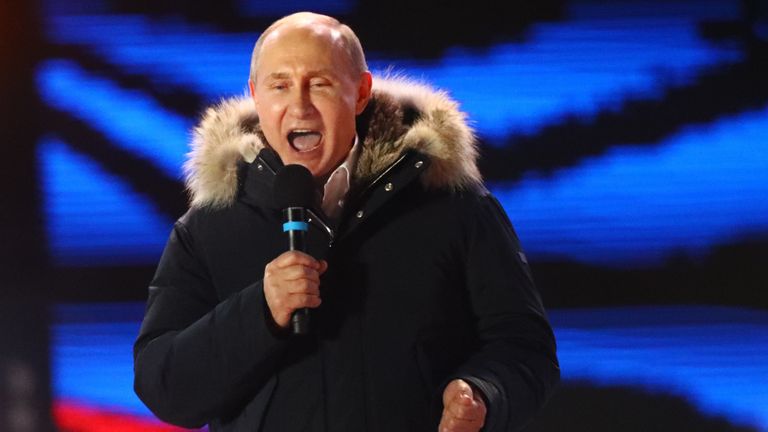
Fresh from a convincing presidential election triumph and a flag and music strewn victory concert in central Moscow, Vladimir Putin took a couple of questions from journalists back at his election headquarters.
Unsurprisingly, he also took a query about his country's fast-expanding diplomatic war with the United Kingdom.
Asked whether Russia was responsible for poisoning former spy Sergei Skripal and his daughter Yulia, he denied any responsibility.
He said: "As for the tragedy that you mentioned, I found out about it from the media.
"The first thing that entered my head was that if it had been a military-grade nerve agent, the people would have died on the spot."
Warming to the theme, President Putin mocked his British accusers.
"It's complete drivel, rubbish, nonsense that somebody in Russia would allow themselves to do such a thing ahead of elections and the World Cup."
:: Putin is president again with 77% of votes
The Russian leader was then undermined somewhat by his campaign chief Andrei Kondrashov, who boasted that the Skripal affair had actually benefited President Putin's election campaign.
He said: "Turnout is higher than we expected, by about 8-10%, for which we must say thanks to Great Britain, because once again they didn't read the Russian mentality correctly."
Unwittingly perhaps, Mr Kondrashov provided those searching for a motive behind the attack with a possible explanation.
:: The secret of Vladimir Putin's appeal
"We were pressured at the exact moment when we needed to mobilise (voters)," he said. Russians had united around the "centre of power".
Certainly, these tensions have done little to harm Mr Putin's popular image as the defender of Russia - the muscle-bound strong man who protects it from the rapacious West.
In fact, he ran his presidential campaign under the slogan "a strong president - a strong Russia," and in a not-too-subtle nod to his prior achievements, the election date coincided with the fourth anniversary of Crimea's annexation by Russia.
With a record 56 million Russians voting for another six years of Putin, he will remain the dominant political force in that country - and by fiddling with the constitution, he could run for another six years in 2024.
For the West that means relations are certain to deteriorate and we approach a new era which could resemble a second cold war.
"The Skripal case makes Putin's Russia even more toxic and nobody - not Putin nor the West - have any practical tactics to improve relations," says Andrei Kolesnikov, a senior researcher at the Carnegie Moscow Centre.
"Putin will continue the besieged fortress approach because it has already proved its efficiency."